Speak up!

Speak up!
Democracy is being tested this year
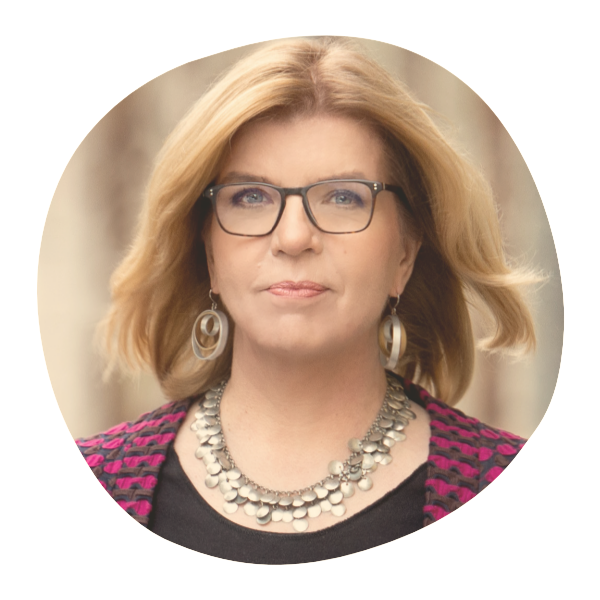
By Eva-Maria McCormack
The year 2026 is only a few days old, yet it has already delivered political shocks that once again call the international order and social cohesion also in Germany into question. These developments demand more than quiet observation and smart analyses. They require us to stand up, take action and assume responsibility. The time is now: Speak up!
Might and Right
2026 did not begin quietly. It started with geopolitical explosions that expose how fragile the global order has become — and how tightly economic interests, power politics and democratic values are intertwined. The openly economically motivated overthrow of Nicolás Maduro’s government in Venezuela and the subsequent takeover of key oil facilities by the United States, President Trump’s threats of a possible annexation of Greenland, and renewed massive Russian attacks on Ukraine all signal a geopolitical course that prioritizes force, control and isolation over international law, cooperation, and solidarity. At the same time, the Iranian population’s struggle for rights, democracy and an end to the theocratic rule of the mullahs continues largely without international attention.
These developments have direct consequences for Europe and Germany. They shape political debates, economic priorities and public sentiment — and they intensify a climate in which security, prosperity and future viability are being renegotiated.
Rollbacks in Germany: social, industrial, ecological
Germany, too, faces political crossroads in 2026. Planned cuts to basic income support and revisions to the Building Energy Act signal a rollback of social and environmental reforms. Social welfare organizations, churches, trade unions and poverty researchers warn loudly against – once again – placing the burden of the socio-ecological transformation primarily on those who are already most vulnerable.
At the same time, the urgently needed transition toward a sustainable economic model is being delayed — as clearly illustrated by the struggles of the German automotive industry. This undermines not only climate action but also a future-oriented industrial policy that secures jobs, fosters innovation and maintains international competitiveness. Blocking investment in sustainability today puts tomorrow’s economic resilience at risk. The reverse is also true: Climate policy is industrial policy.
Growing social inequality has become a new fault line in domestic politics. While wealth and profits are increasingly concentrated among a small elite, large parts of the middle class are under pressure. “Almost one in five people in Germany is at risk of poverty — poverty is therefore not an exception but a structural risk to our society,” Germany’s Federal Statistical Office reported in 2025. Rising living costs, insecure employment and the erosion of social safety nets undermine trust in social cohesion and in democracy itself.
Toward an anti-democratic democracy
The political outlook is particularly alarming in the 2026 “super election year”. State elections will be held in six federal states. Especially in eastern Germany, the AfD — classified as a far-right extremist party Germany’s domestic intelligence agency, the Office for the Protection of the Constitution — appears poised for record gains and could even dominate state parliaments or enter federal governments. This poses a serious threat to democratic institutions, minority rights and social peace.
This development did not emerge out of nowhere. It is fuelled by real social anxieties, economic insecurity and a widespread sense of political neglect. But the AfD and other right-wing populist actors offer no solutions. They deepen divisions, undermine democratic processes and deceive their voters when they claim to represent “ordinary people.” A look at the AfD’s own election programme shows: Society’s most vulnerable would be the biggest losers under ther policies.
The United States: Alarming echoes from the past
The United States currently offers a stark example of how quickly a democracy can be hollowed out from within. A core assumption of the postwar order — that elected governments would feel bound by democratic principles — has proven dangerously naïve.
Fundamental pillars of democratic society are being attacked at speed: even basic forms of social protection, the independence of the judiciary, the autonomy of the central bank, academic freedom as well as cultural memory institutions such as museums, archives and collections. History shows how dangerous such dynamics are. In Germany, only weeks passed between Adolf Hitler’s democratic election as chancellor in March 1933 and the Enabling Act that eliminated opposition and established the Nazi dictatorship.
Dangerous discursive shifts are visible in Germany. The work of NGOs and volunteer organizations working on democracy and civic education is openly questioned by MPs. Debates around basic income support focus narrowly on alleged abuse instead of structural poverty and fears of downward mobility. This distracts from the real threat to social cohesion: It is growing wealth concentration and unequal opportunities, not “those at the bottom”.
Everything Is connected: Democracy, Climate, Social Justice, Resilience
One key insight defines the current time of transformation: Sustainability, climate action, social justice, democratic stability and psychosocial resilience are deeply interconnected. Cutting social protection erodes trust in democracy. Blocking climate action endangers economic stability and social cohesion. Undermining democracy destroys the foundation for fair solutions in every other area.
Societies are only future-ready when people feel heard, protected and included. When fear and powerlessness prevail, authoritarian promises gain appeal.
“… ask what you can do for your country”
Our democracy and social contract are not guaranteed. They are the result of struggle, compromise and courageous engagement. And they can be lost if we merely “consume” them instead of actively defending them.
Now is the time to stand up. Civil courage, civic engagement, everyday solidarity and the conscious decision to vote are not optional. They are the foundation of an open society.
Democracy survives only if we intervene, object, support one another and take responsibility. Not someday, but now.

We need spaces for dialogue, courage, connection – and action
This is what we at Talking Hope are committed to. In our work, we aim to create spaces where people can voice their fears, concerns and hopes and then take action together. Spaces where psychosocial resilience is understood as a societal resource for political agency and for shaping a sustainable and democratic future.
In times of multiple crises, we need places where dialogue is possible, complexity can be held and solidarity can grow. Those who are heard feel less powerless. Those who can share hope remain capable of action.
Speak up!
So let’s get involved. Support initiatives that connect democracy, social justice and climate action. Vote. Demonstrate. Have the courage to engage with people who think differently. Engage with people who are different. Speak out when human dignity is relativized. Strengthen organizations that empower people to raise their voices. Our society can handle many different opinions — as long as the conversation remains democratic. Only silence is not an option.
Share this Post:
 EN
EN  DE
DE